Molybdenum:
properties, materials and industrial uses
Molybdenum is a refractory transition metal used across steelmaking, superalloys, chemical catalysis, lubrication, high-temperature engineering, electronics and glass production.
Most of the metal consumed worldwide is added to steel as ferromolybdenum, in amounts that raise strength, hardenability and high-temperature performance. The remainder is used in superalloys, in catalysts and chemicals, in solid lubricants, in electronic and display thin films, and in specialist high-temperature hardware.
The element is not a rare-earth element, but industry groups it with the rare metals because it is traded in smaller volumes and needs specialised processing. That places it in the same materials family as vanadium, rare earths and zirconium — a family of materials in which the behaviour of the material, not only its chemistry, decides how it is specified.
Molybdenum at a Glance
Three facts shape almost every first conversation about molybdenum:
Molybdenum at a glance
- Element:
- Mo — atomic number 42, a group 6 transition metal.
- Melting point:
- approximately 2,622 °C, which is why the metal is specified for high-temperature service.
- Three industrial roles:
- an alloying element in steels and superalloys, a chemical intermediate and catalyst, and a solid lubricant.
The sections below follow that order: what the element is, how it behaves, which materials carry it into industry, and where it is used.
What Is Molybdenum?
Molybdenum is a transition metal — element 42, group 6 of the periodic table. It is not a rare-earth element and not a precious metal. Its industrial value rests on three different behaviours: as an alloying addition, as a chemical intermediate and catalyst, and as a solid lubricant.
The name comes from molybdos, the Greek word for lead: molybdenite was long confused with lead ore and, later, with graphite. Carl Wilhelm Scheele showed in 1778 that it was a distinct substance, and Peter Jacob Hjelm isolated the metal in 1781.
Commercially, the element rarely arrives as a single substance. It reaches industry as ferromolybdenum, as the trioxide or another intermediate, as a molybdate salt, as refined metal and powder, or as a lubricant-grade disulfide. Each form carries its own specification, packaging and handling requirement, which is why a requirement is best described by form and function rather than by the word “molybdenum” on its own.
Molybdenum Properties
Molybdenum combines a refractory-metal melting point with a stiffness and thermal expansion that serve both metallurgical and electronic applications, together with a strong tendency to form stable carbides and oxides. That combination explains most of its uses.
Symbol and position
Mo — atomic number 42, a group 6 transition metal in period 5 of the periodic table.
Melting point
Approximately 2,622 °C, among the highest of the metals used in load-bearing service.
Boiling point
Approximately 4,639 °C.
Density
About 10.2 g/cm³ — roughly half the density of tungsten, and heavier than steel.
Oxidation states
Molybdenum spans oxidation states from -2 to +6. The +6 state dominates its industrial chemistry.
Carbide formation
Molybdenum forms stable carbides, which is the basis of its secondary-hardening role in tool and high-speed steels.
Thermal expansion
Among the lowest of the engineering metals — close to that of borosilicate glass, which is why molybdenum seals into hard glass.
High-temperature strength
Molybdenum keeps useful strength and creep resistance well above the range of ordinary steels, provided it is protected from oxidation.
Oxidation behaviour
Unprotected molybdenum oxidises in air above roughly 600 °C, so high-temperature parts depend on atmosphere control or a protective coating.
Interstitial sensitivity
Oxygen, nitrogen and carbon strongly influence the metal, so interstitial limits are part of the specification for critical parts.
Values such as melting point, density and impurity limits are material properties, not a guarantee of performance in a given process. For critical applications the applicable specification and the accompanying certificate of analysis remain the reference.
Molybdenum Materials
The material is traded in several forms, and the form usually decides the buying decision more than the element does.
Ferromolybdenum (FeMo)
The master alloy added to steel melts, specified by molybdenum content and impurity limits.
Molybdenum trioxide (MoO₃)
The principal industrial intermediate: the feedstock for metal, ferroalloy, catalysts and chemicals.
Sodium molybdate (Na₂MoO₄)
A water-soluble molybdenum salt used in water treatment, micronutrients and as a chemical intermediate.
Ammonium molybdate
A molybdenum salt used as an analytical reagent, a catalyst precursor and a source of high-purity molybdenum.
Molybdenum metal
Bar, rod, plate, sheet, wire and fabricated parts for high-temperature, glass, electronics and furnace use.
Molybdenum powder
Controlled particle-size powder for powder metallurgy, alloy production, sputtering targets and additives.
Molybdenum disulfide (MoS₂)
A layered solid lubricant, supplied as powder, in greases, in bonded coatings and as an additive.
Molybdenum-bearing secondary materials
Spent catalyst, alloy scrap and other residues processed for recovery.
Master alloys such as ferromolybdenum are specified by their content and impurity limits. Metal and powder are specified by purity, interstitial content and particle size. The oxide and the molybdate salts are specified by chemical composition and by the process they have to perform.
Molybdenum Compounds
Beyond the metal, a good part of the trade under discussion is chemistry. The commercial compounds share a common origin — molybdenum trioxide — and then diverge to serve very different industries.
Molybdenum trioxide (MoO₃)
The most important commercial molybdenum compound and the gateway to most other products.
Sodium molybdate (Na₂MoO₄·2H₂O)
A soluble salt used as a corrosion inhibitor and as a source of molybdenum in solution.
Ammonium molybdate
Usually supplied as ammonium heptamolybdate; used in analysis, catalyst preparation and metal production.
Molybdenum disulfide (MoS₂)
The naturally layered sulfide that gives molybdenum its lubricant role and is a precursor to catalysts.
Heteropoly and “molybdenum blue” chemistry
Speciality molybdenum chemistry used in analysis and in some catalyst systems.
Molybdenum metal powder
A metallurgical form rather than a chemical salt, specified by purity and particle size.
Compounds are bought against a chemical analysis rather than a microstructure, and several of them are dust-forming or water-soluble, so handling, packaging and transport classification are part of the product rather than an afterthought. As with the metal, the requirement is clearest when it names the compound and the process it serves.
Molybdenum Trioxide
Molybdenum trioxide (MoO₃) is the hinge of the industry. Most molybdenite concentrate is roasted to a technical-grade oxide, and from that point the material can go in several directions at once.
Treated as an intermediate, MoO₃ is the feedstock for the metal, for ferromolybdenum, for catalysts and for the molybdate salts used elsewhere. Treated as a product, it is itself used in catalysts, pigments and lubricant chemistry.
The high-purity oxide is a demanding product: purity, particle size and the trace elements that would affect a downstream catalyst or a glass-melting electrode all belong in the specification. TAIYO KOKO began mass production of high-purity molybdenum trioxide in 1997.
Sodium Molybdate
Sodium molybdate (Na₂MoO₄) is the water-soluble way to deliver molybdenum into a process. It is supplied as a crystalline salt and is specified by assay, pH and the impurities that matter to the receiving application.
- Water treatment. Molybdate is a low-toxicity corrosion inhibitor, including in closed-loop and cooling-water systems.
- Micronutrients. Molybdenum is an essential trace element for plants and for some enzyme systems, so molybdates appear in fertiliser and feed products.
- Chemical intermediate. Sodium molybdate is a convenient soluble source for making other molybdenum compounds and catalysts.
Because it is soluble, the same properties that make it useful also set the handling requirement: dust control and containment matter, and the product is usually traded with a defined assay and a documented impurity profile.
Ammonium Molybdate
Ammonium molybdate — usually supplied as ammonium heptamolybdate — is the main ammonia-route molybdenum salt. It bridges the oxide and the higher-purity products, and it is the form most often used where molybdenum has to be delivered in solution.
- Analytical chemistry. Ammonium molybdate is a standard reagent for the determination of phosphate and silicate.
- Catalyst manufacture. It is a common precursor for molybdenum-based catalysts, applied from solution onto a support.
- High-purity molybdenum. It is a stepping stone to high-purity oxide and metal for demanding applications.
TAIYO KOKO began producing ammonium molybdate in 1954, and it has remained part of the product range since. As with the other salts, assay, impurity limits and packaging are the data that decide whether a batch is suitable.
Molybdenum in Steel
Steel is where most molybdenum goes. Additions are measured in fractions of a percent to a few percent, but their effect is large: it raises hardenability, holds strength in thick sections, resists softening at temperature and forms carbides that survive severe service.
The usual route into a steel melt is ferromolybdenum. TAIYO KOKO began producing it in 1952 and added a fine powder grade — for processes that need a finer, faster-dissolving addition — in 1995.
Structural and Alloy Steel
Molybdenum-bearing structural and alloy steels are used where strength and toughness must be held in thicker sections: pressure vessels, gears, shafts, mining and lifting equipment, and high-temperature bolting.
Stainless and Corrosion-Resistant Steel
It improves resistance to pitting and crevice corrosion, which is why grades such as the 316 family and their higher-molybdenum relatives appear in chemical plant, marine and process environments.
Tool and High-Speed Steel
In tool steels, the element provides secondary hardening: carbides that form during heat treatment keep the tool hard at the temperatures generated in cutting. High-speed steels such as the M-series rely on this effect.
Welding Consumables and Powder Metallurgy
Molybdenum also appears in welding consumables and in powder-metallurgy parts, where it is added as powder or through a master alloy. In every case the content, the impurity limits and the form of the addition are what the process is specified against.
Molybdenum in Superalloys
Molybdenum is a core alloying element in nickel- and cobalt-based superalloys. It dissolves in the matrix and strengthens it, slowing the deformation that creep causes at high temperature.
- Solid-solution strengthening. It is a heavy atom that distorts the lattice and resists the movement of dislocations at temperature.
- Corrosion resistance. It contributes to resistance to pitting and reducing-acid attack in aggressive process environments.
- Application range. Superalloys of this family appear in gas-turbine hot sections, chemical and petrochemical plant, and high-temperature fasteners.
Because superalloy compositions are tightly controlled, molybdenum for this use is specified with a narrow chemistry window, and the metal or powder is chosen to hold that window without introducing harmful trace elements.
Molybdenum in Aerospace
Aerospace and defence use the metal where the temperature is too high for ordinary alternatives but where weight and oxidation still have to be managed.
- High-temperature structures. Molybdenum and its alloys such as TZM are used for parts exposed to very high temperature, often with a protective coating.
- Rocket and propulsion hardware. It withstands the temperatures found in nozzle and throat components.
- Thermal management. The metal's combination of high-temperature capability and good thermal conductivity suits certain heat-management parts.
These are engineering applications first: the material is selected for its behaviour at temperature, and the specification, coating and inspection regime are part of the design rather than an add-on.
Molybdenum Catalysts
Catalysis is the largest non-metallurgical use of molybdenum. The active phase is usually a molybdenum sulfide, often promoted by cobalt or nickel and dispersed on a support.
- Hydrodesulfurization (HDS). Cobalt-molybdenum and nickel-molybdenum catalysts remove sulfur from petroleum fractions — one of the largest single uses of molybdenum in chemistry.
- Other refining reactions. The same catalysts also take part in hydrotreating and related upgrading steps.
- Selective oxidation. Molybdenum oxide systems catalyse a number of oxidation and selective-conversion reactions.
Catalyst manufacture is a specification-heavy business: the molybdenum content, the promoter ratio, the form of the pre-catalyst and the properties of the support all affect performance, and the active phase is usually applied from solution.
Spent catalyst is also a resource of the metal, which is why recovery and catalyst manufacture are closely connected in this market.
Molybdenum Disulfide Lubricants
Molybdenum disulfide (MoS₂) is a layered solid that shears easily between its layers, which is what makes it a lubricant rather than an abrasive.
- Extreme pressure and high load. MoS₂ keeps working where a fluid film would break down.
- Vacuum and dry environments. It lubricates where a conventional oil or grease cannot be used, including vacuum applications.
- Running-in and coatings. Thin MoS₂ films reduce friction during running-in and protect surfaces in harsh conditions.
Lubricant-grade MoS₂ is specified by purity, particle size and crystalline form, because those factors decide how well it performs on a surface. Its layered chemistry is also the starting point for molybdenum-based catalysts.
Molybdenum in High-Temperature Applications
Molybdenum's melting point places it in a small group of metals that can be used in genuine high-temperature service. In practice it appears where the atmosphere can be controlled or the part protected.
- Furnace and hot-zone parts. Heating elements, shields, supports and fixtures in vacuum or protective-atmosphere furnaces.
- Glass and ceramics. Molybdenum electrodes and hardware for melting glass, helped by its low thermal expansion and compatibility with hard glass.
- TZM and similar alloys. Titanium-zirconium-molybdenum alloys raise the recrystallisation temperature and strength of the unalloyed metal.
- Protective coatings. Where a part must face air at temperature, a coating system is part of the material choice.
The engineering rule is simple: the metal is excellent in the right atmosphere and unsuitable in the wrong one, so the process environment belongs in the specification — as it does in the wider engineering guidance for material selection.
Molybdenum in Electronics
The metal has a growing role in electronics, where its thermal and mechanical behaviour is as important as its electrical properties.
- Sputtering targets. Molybdenum targets deposit thin films for displays and semiconductor devices.
- Flat-panel displays. Molybdenum and molybdenum-alloy films form conductive layers in thin-film-transistor displays.
- Semiconductor devices. It appears in gate and barrier metallurgy and in thin-film stacks, chosen for stability at processing temperature.
- Thermal management. Molybdenum–copper composites spread heat in power electronics and high-power devices.
- Sapphire and crystal growth. The metal is used in high-temperature crystal-growth equipment.
Targets and thin-film products are specified by purity, density and microstructure, because film quality follows directly from target quality.
Molybdenum Applications by Industry
Read as a list of industries, molybdenum's reach becomes clear:
- Steelmaking
- Oil and gas
- Chemical processing
- Automotive and mobility
- Aerospace and defence
- Power generation
- Glass and ceramics
- Electronics and semiconductors
- Medical and dental
- Mining and mineral processing
- Analysis and research
- Renewable and process energy
The same element appears in very different roles across those industries: an alloying addition in steel, a strengthener in superalloys, an active phase in catalysts, a solid lubricant, a thin-film material and a high-temperature engineering metal. That range is why the requirement is best written against a specific process rather than against a general material description, and it is the same rule the applications we cover are built on.
Molybdenum Supply Chain
Molybdenum supply is unusual because a large share of it is produced as a by-product. Some deposits are mined for the metal as the principal product, but much of the world's output is recovered alongside copper from large porphyry systems. That makes part of the supply story a story about copper economics.
The United States Geological Survey estimates world mine production at about 260,000 tonnes of molybdenum in 2025, with world reserves of roughly 17 million tonnes. In that estimate the largest producers were China (about 97,000 tonnes), Chile (about 42,000 tonnes), the United States (about 40,000 tonnes) and Peru (about 39,000 tonnes).
Each stage is a different industry with a different trade pattern, and the molybdenum content — not the gross weight — is what moves through the chain. USGS publishes annual production and reserve data, and that is the right starting point for any supply assessment. The same by-product pattern repeats across the industrial supply chains this site follows, and it is why price and demand context can move independently of mine output.
Molybdenum Processing
From ore to usable product, the material follows a well-established pyrometallurgical and hydrometallurgical route:
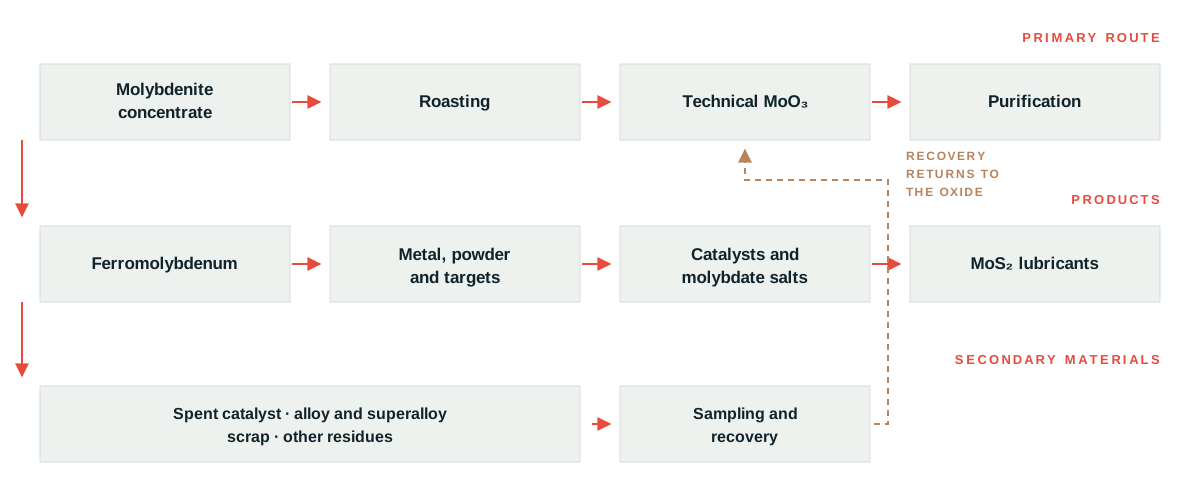
- Mining. Molybdenite is recovered from dedicated molybdenum deposits and, more often, as a by-product of copper mining.
- Concentration. Ore is crushed, ground and floated to a molybdenite concentrate.
- Roasting. The concentrate is roasted to technical-grade molybdenum trioxide, with the sulfur driven off.
- Purification. Further processing produces high-purity oxide, and ammonia chemistry converts it into molybdate salts.
- Metallurgical reduction. Oxide is reduced to molybdenum metal powder, which is then consolidated into metal mill products.
- Alloying. Ferromolybdenum is produced for steelmaking, and molybdenum metal or powder feeds alloy and superalloy melts.
The first two stages produce a concentrate; roasting converts the sulfide to oxide; the later stages divide into the chemical route — salts and catalysts — and the metallurgical route — metal, powder and ferromolybdenum. Which route a batch takes is decided by the specification of the product that will be made from it.
Molybdenum Recycling
The metal keeps value in every form it takes, so it is recovered from spent catalyst, from alloy and superalloy scrap, and from steelmaking residues. The USGS notes that the molybdenum recycled as part of new and old scrap may be as much as 30% of apparent supply, even though there are few dedicated processes for refining secondary metal out of its alloys — most of what is available in scrap is simply reused inside new alloy melts.
TAIYO KOKO has recovered molybdenum and vanadium from spent catalyst since its recovery plant was completed in 1978, which is why recovery is treated here as established industrial practice rather than as a proposal.
- Collection and sorting. Spent catalyst, alloy scrap and other molybdenum-bearing residues are collected and separated by form and molybdenum content.
- Sampling and assessment. Each batch is analysed so that the recovery route, the expected yield and any pre-treatment requirement can be planned.
- Preparation. Material is de-oiled, crushed or otherwise conditioned for the recovery process.
- Recovery. Roasting and leaching, or a hydrometallurgical route, bring the molybdenum into solution or into a processable intermediate.
- Purification. The intermediate is refined towards a saleable specification such as technical molybdenum trioxide or ferromolybdenum.
- Return to use. Recovered molybdenum re-enters steel, chemical or catalyst production with the documentation the receiving process requires.
Recovery does not remove the need for primary supply: the content of scrap and catalyst varies widely, and each recovery route has to be justified batch by batch. It does mean that molybdenum tends to stay inside industrial cycles for a long time.
Molybdenum Supply Security
Molybdenum is not scarce — USGS describes resources as adequate to supply world needs for the foreseeable future, and notes that there is little substitution for it in its main application in steels and cast irons. The security questions are therefore about concentration and co-production rather than about geology.
- Production concentration. China accounts for a large share of world mine production, so supply and trade policy in one country can move the whole market.
- By-product dependence. Because much of the supply comes with copper, output follows copper mining plans and can fall even when demand is steady.
- Limited substitution. In steel and cast irons there is little substitution, so demand is relatively insensitive to price in the short run.
- Recycling and stock. Secondary supply and strategic stockpiles both damp the effect of a supply disruption.
For buyers the practical response is diversification, visibility of the full chain, and a specification that does not over-constrain the material beyond what the process needs. Our technical notes cover related material questions in more depth.
Molybdenum Metal vs Molybdenum Compounds
Molybdenum metal
- Refractory metal with a very high melting point
- Used to make ferromolybdenum and to alloy steels and superalloys
- Supplied as bar, plate, sheet, wire, powder and sputtering targets
- Specified by purity and interstitial content
- Handled as a normal industrial metal
Molybdenum compounds
- Molybdenum trioxide, sodium and ammonium molybdate and similar intermediates
- Used as catalysts, chemical feedstocks, pigments and micronutrients
- Specified by chemical composition and product performance
- Dust-forming or water-soluble, so control measures matter
- Transport classification and documentation apply
The practical difference is the specification. Metal purchases turn on purity, microstructure and particle size; compound purchases turn on chemical analysis and on the process the material has to perform. Treating the two as one product category is the most common source of a mismatched requirement.
If the requirement is a permanent magnet rather than a metallurgical or chemical material, the right starting point is the NdFeB magnet guide, not this page.
Choosing a Molybdenum Material
Molybdenum selection is really a specification exercise. Work through the following list and most of the technical risk is removed before an enquiry is placed:
- Application and required function. What the material has to achieve in the process, not only what it is called.
- Material form. Ferromolybdenum, oxide, molybdate salt, metal, powder, disulfide lubricant or secondary material.
- Chemical composition. Molybdenum content for master alloys, or purity and impurity limits for metal, oxide and salts.
- Particle size. For powders and lubricants: the particle-size distribution, and whether a specific cut or range is required.
- Quantity. Batch size and expected annual or project volume.
- Packaging and transport. Packaging format, unit weight and the transport classification that applies to the product.
- Documentation. Certificate of analysis, safety data sheet and any process or standard the material must be released against.
- Delivery. Destination, required date and how the material will be received and stored.
Need a molybdenum material for a specific process?
Describe the form, the quantity and the process the material has to perform in. That level of detail is usually enough to confirm a suitable route and the documentation your process needs; the procurement pages show how a requirement like this becomes a specification that can be quoted and released.
Start an enquiryMolybdenum Milestones
Molybdenum has been part of TAIYO KOKO's product range since the company was founded in 1949, when molybdenum ore mining and roasting began, and part of its recovery operations since the 1970s. The audited corporate timeline records these milestones:
1949
Taiyo Sangyo is dissolved under the corporate rehabilitation law and TAIYO KOKO is founded: molybdenum ore mining and roasting and titanium alloy production begin, and Japan's first zirconium products are developed.
1952
Ferromolybdenum production begins.
1954
Ferrovanadium and ammonium molybdate production begin.
1978
The rare metal recovery facility and recycling plant for spent catalyst are completed — the start of commercial spent catalyst recovery.
1995
Ferromolybdenum fine powder production equipment starts operation.
1997
Mass production of high-purity molybdenum trioxide and production of vanadium metal powder begin.
The same timeline is published in full on the corporate history page of the Japanese site.
Frequently Asked Questions
What is molybdenum?
Molybdenum is a transition metal with the chemical symbol Mo and atomic number 42. It sits in group 6 of the periodic table and is used mainly as an alloying element in steels and superalloys, as a chemical intermediate and catalyst, and as a solid lubricant.
Is molybdenum a rare earth element?
No. Molybdenum is a transition metal, not one of the rare-earth elements. In industrial usage it is often grouped with the “rare metals” — metals traded in smaller volumes that need specialised processing — which is why it appears alongside vanadium, rare earths and zirconium in the same materials family.
What is molybdenum used for?
Most molybdenum is consumed in steels and cast irons, where it raises strength, hardenability and high-temperature performance. Other uses include superalloys, hydroprocessing catalysts, solid lubricants, pigments, electronic and display thin films, and high-temperature furnace and glass-melting hardware.
What is ferromolybdenum?
Ferromolybdenum is an iron-molybdenum master alloy that is added to steel melts to reach the required content. It is the usual commercial route for introducing it into steel, because it dissolves predictably and is easier to handle than the pure metal.
Why is molybdenum added to steel?
Molybdenum increases hardenability, holds strength and toughness in thick sections, forms carbides that provide secondary hardening in tool and high-speed steels, and improves resistance to pitting and crevice corrosion in stainless grades.
What is molybdenum trioxide used for?
Molybdenum trioxide (MoO₃) is the principal industrial intermediate. It is the feedstock for the metal and for ferromolybdenum, and it is used to make catalysts, pigments and lubricant chemistry.
What is molybdenum disulfide used for?
Molybdenum disulfide (MoS₂) is a layered solid lubricant used in greases, bonded coatings and dispersions where loads are high, speeds are low, or a conventional fluid film cannot survive. Its layered chemistry is also the starting point for molybdenum-based catalysts.
What are the main industrial forms of molybdenum?
Ferromolybdenum, molybdenum trioxide, sodium and ammonium molybdate, metal and powder, the disulfide lubricant, and molybdenum-bearing secondary materials such as spent catalyst and alloy scrap.
Where does molybdenum come from?
Molybdenum is recovered from dedicated deposits and, more often, as a by-product of copper mining. The main producing countries are China, Chile, the United States and Peru. The USGS estimates world mine production of about 260,000 tonnes in 2025 and world reserves of roughly 17 million tonnes.
Can molybdenum be recycled?
Yes. It is recycled as a component of catalysts, ferrous scrap and superalloy scrap. The USGS notes that the recycled fraction in new and old scrap may be as much as 30% of apparent supply, and that the content of recycled alloys is significant and reused.
How should a molybdenum requirement be specified?
By the process it has to perform, the form, the chemical composition and purity, the particle size for powders, the quantity, the packaging and transport classification, the documentation, and the delivery requirement — verified against the current datasheet, the applicable standard and the specific process.
Conclusion
Molybdenum is a material that hides in plain sight. In steel it quietly decides how much load a section can carry and how well it survives heat and corrosion; in superalloys it holds strength where ordinary metals would creep; in catalysis it drives one of the world's largest refining processes; as a solid lubricant it keeps surfaces moving where a fluid film cannot; and in electronics it forms the thin films and heat paths that devices depend on.
That breadth is why the material deserves to be specified carefully. The common mistake is not choosing the wrong grade — it is describing the requirement with a material name instead of a process, a form and a set of limits.
Read on those terms, molybdenum is a mature industrial material with a long supply history, a wide product range and a recovery route that has operated at industrial scale for decades.